This week: October 2, 2026 - Charles Hart - Hold the Standard - Keep the Human



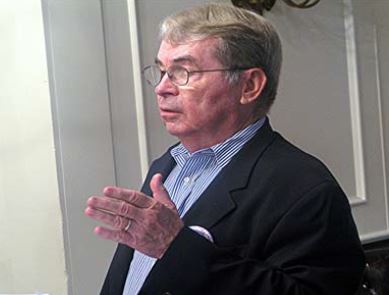
Last week’s breakfast speaker was club president Gary Lett who returned to the club after an extended absence. Gary used the occ a s i o n t o t a l k a b ou t “sequestration” of Federal Government funds, and indicated that a reduction as high as 20% has been suggested for Federal Defense- which affects not only government employees but many corporations contributing to the country’s National Defense. One such corporation is Gary’s employer—Northrup Grumman—who develop innovative solutions and remarkable technologies in aerospace and defense. Gary added idly “will I still have a job?”
Gary went on to say that “the scope of Northrup Grumman operations (as well as those of other corporations) is broad enough to adjust to this : changing of gear.” It will be individual employees and small companies who will truly suffer from a significant Defense budget and other cuts.
“We are in a cyber war with the Chinese,” Gary observed, after which there was quite a discussion about Northrup Grumman;s expertise and activities in the Cyber Space Field.
[list style=”idea”]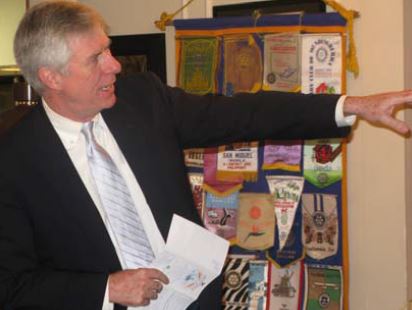
Donald Mooers is a highly regarded Bethesda attorney whose law practice is dedicated exclusively to Immigration and Nationality Law. While in college, he joined the Peace Corps, which led to his still current dedication to improving the status of residents in Sierra Leone in Africa, He also has had a very happy family life.
Don (in his talk) said that every person’s maxim should be “Do What You Can-Where You Are—and to the Best of Your Ability.” He then guided us through one of the greatest success stories he knew—his own! He was able to find work outside his home at age ten—is a graduate of Churchill High School in Montgomery County, Duke University and GWU Law school, and has a formidable volunteer schedule.
During his senior year at Duke, Don entered the Peace Corps and soon became dedicated to rescuing young people from the dire conditions in Sierra Leone. He helped many of them to move to America where they are getting along superbly. Sierra Leone is a small country on the ocean side of Africa, Civil war raged there in the 1990’s and ordinary punishment was cutting off an arm or foot of protesters. Today, restored, and average life expectancy is up to 56 for males, and 59 for males.
[list style=”idea”] [/list]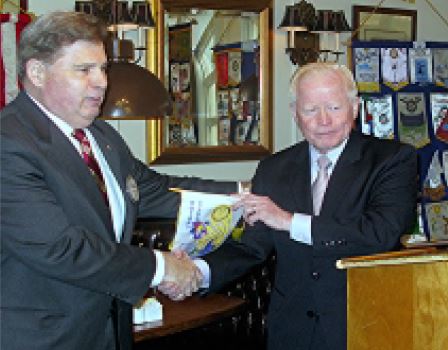
Last week’s breakfast speaker was Jose L.Cuisia, Jr., the Ambassador of the Philippines to the United States for the past two years. His educational degrees include a B.A. degree in Social Science from the Wharton School in the University of Pennsylvania.
There are 11 principal Philippine islands, with the Pacific Ocean to the East and the South China Sea on the West. The most important island is Luzon in the far north, with the capital city of Manila (population about 1.6 million). One of the finest harbors in the world is Manila Bay.
During their years as a territory of the USA, the Philippines became important in world commerce, and today they have been projected to be the 14th largest economy in the world. The Independence of the mother country dates from July 4, 1776, while that of the Philippine Republic dates from July 4, 1946.